Announcing the Selected Projects Across Seven Countries
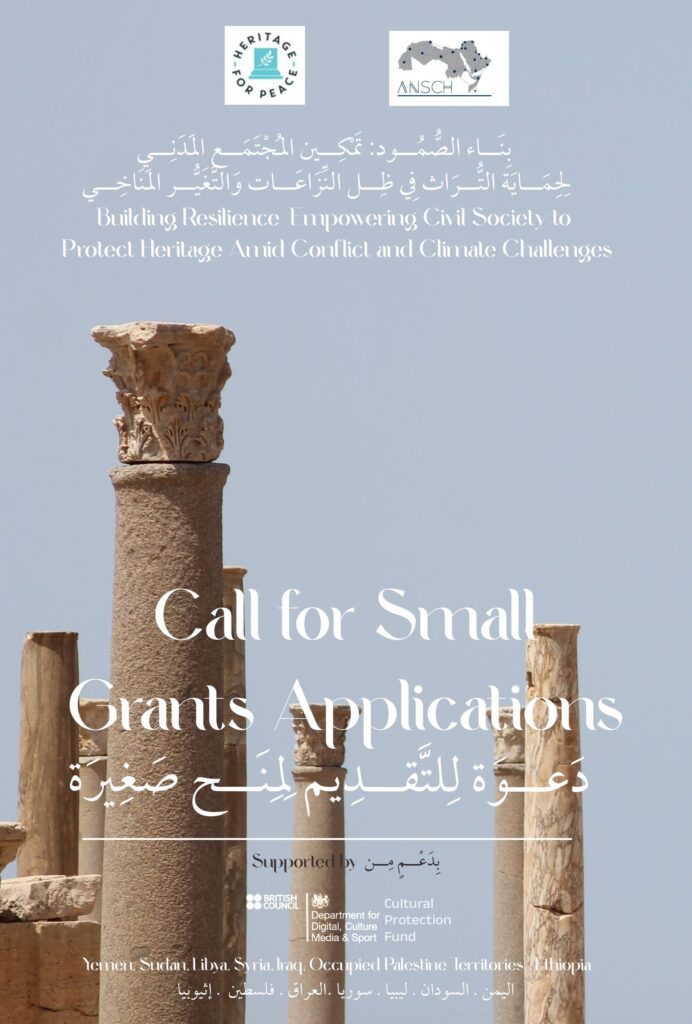
ANSCH – the Arab Network of Civil Society Organizations to Safeguard Cultural Heritage is pleased to announce the selected projects under the program “Building Resilience: Empowering Civil Society to Protect Heritage Amid Conflict and Climate Challenges.” These projects have been chosen from seven countries affected by conflict and climate-related challenges, including Yemen, Syria, Iraq, Libya, Palestine, Sudan, and Ethiopia.
The selected projects underwent a rigorous evaluation process and were implemented through close collaboration with key partners, foremost among them Heritage for Peace, with funding from the British Council’s Cultural Protection Fund. They aim to support locally led initiatives driven by civil society to safeguard cultural heritage and strengthen its resilience in times of crisis.
The full list of selected projects can be found in the attached document, which includes each project’s title, location, and a brief description outlining its objectives, activities, and expected impact in protecting heritage and empowering local communities.
About the Project
Cultural heritage is increasingly at risk in many fragile and conflict-affected contexts. Armed conflict, political instability, climate change, flooding, extreme heat, neglect, and displacement are accelerating the loss of both tangible and intangible heritage, while also weakening the conditions needed for its protection.
Heritage sites, historic places, and traditional knowledge are facing growing threats from destruction, environmental disasters, and social disruption. In many of these contexts, limited international access and weakened public institutions make local action more important than ever.
Civil society organizations are often the most present and responsive actors on the ground. They play a vital role in documenting heritage at risk, implementing urgent protection measures, preserving traditional knowledge, and working directly with communities to safeguard cultural heritage.
Why This Project
This project was developed to support and empower civil society organizations as key actors in protecting heritage under difficult and rapidly changing conditions. As a six-month regional initiative, it focuses on Yemen, Sudan, Libya, Syria, Iraq, Palestine (Gaza), and Ethiopia (Tigray), where local leadership is essential for effective action.
The project combines competitive small grants, specialized training, monitoring and evaluation mechanisms, and stronger cooperation among local actors. Through this integrated approach provides funding, knowledge, and capacity-building opportunities that help organizations design and implement practical, locally led, and sustainable interventions for heritage protection.
Rather than remaining at the level of discussion, the project is designed to support concrete action on the ground. It seeks to strengthen local capacities, encourage collaboration, and generate results that directly respond to urgent risks facing cultural heritage.
Implementing and support agency
This project is implemented by ANSCH Network, established by Heritage for Peace, and funded by the British Council.
ANSCH Network brings together approximately 23 organizations from 7 countries, operating under the initiative’s umbrella through established prior partnerships. The project translates the vision of ANSCH into tangible actions—enabling more effective, locally led, and sustainable heritage protection. It was developed as a direct, practical response to the objectives of the ANSCH initiative, which aims to strengthen the role of civil society organizations in safeguarding cultural heritage in fragile and conflict-affected contexts.
Civil society organizations play a critical role as the most present and responsive actors on the ground. Their role includes implementing immediate protection measures, documenting at-risk heritage, preserving traditional knowledge, and engaging local communities in preservation efforts.
Small Grants Program
The program offers small grants totaling up to £75,000, funding 12 to 15 projects at up to £5,000 each, to be implemented over 3 to 4 months. These grants are designed for rapid, effective responses to urgent risks threatening heritage.
Expected Learning Outcomes
The project delivers training workshops for civil society organizations, featuring two intensive days each month. These workshops aim to build organizational capacity through diverse modules, including:
Grant application processes and funding opportunities
Strategic proposal writing and development
Project management in fragile and conflict-affected contexts
Budget preparation and financial reporting
Technical documentation and photographic recording
Responsible media use and communication strategies
Call for Applications Now Open
The Small Grants Programme is now open for applications as part of the Building Resilience: Empowering Civil Society to Protect Heritage Amid Conflict and Climate Challenges initiative. The programme supports locally led, practical interventions to protect cultural heritage at risk in Yemen, Sudan, Libya, Syria, Iraq, Palestine (Gaza), and Ethiopia (Tigray), through grants of up to £5,000 for projects implemented over 3 to 4 months.
Applicants are strongly encouraged to review the guidance carefully before submitting their applications. The guidance provides important information on eligibility, supported activities, application requirements, and selection criteria to help organizations prepare strong and relevant proposals. Please read the English Guidance Note and the Arabic Guidance Note before completing the application form.
How to apply?
To apply, please complete all mandatory fields in the Online ApplicationForm no later than 14 April 2026. Preliminary selection will be completed by 30 April 2026. Shortlisted applicants will be invited to an online interview during the first week of May 2026.
Partners